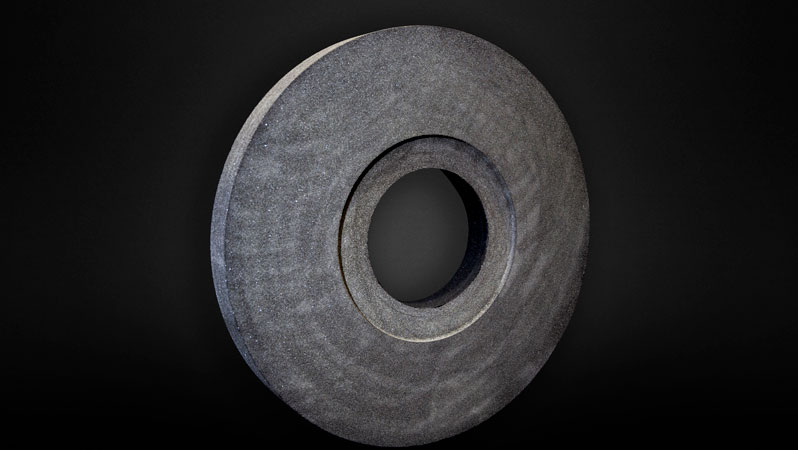
From our stable of abrasive products there is one universally recognised leader ‘Phoenix’. Steeped in history and experience this range of Roll Grinding wheels provides an abrasive solution for all roll grinding applications.
The ‘Phoenix’ wheels will be found throughout the world grinding long, large diameter rolls in steel and aluminium rolling'smills, paper mills, rubber and plastic processing plants. Employing up-to-date abrasive technology, wheel grades are formulated using a proven range of soft, medium or hard bond structures – Organic or Shellac.
Abrasive grit combinations of Aluminium Oxide, Silicon Carbide and Ceramic grains are selected for optimum wheel performance given the parameters of Roll finish requirements. Roll Grinding wheels incorporating the higher cost ceramic grain will produce a marked improvement in productivity and G-ratios. End users report longer wheel life and the capability to rough and finish with the same wheel
Phoenix have over the last 40 years gained considerable expertise in grinding wheel formulations to provide the optimum grinding wheels for the many various grinding applications. Not only are the grinding characteristics of the roll to be ground important, there is also the machines which can have outputs from below 10 horsepower per 25 mm of wheel face through to high horsepower machines.
These considerations are vital in establishing the grinding wheel formulation which will give superior product performance able to grind to tolerances plus and minus 20 millionths of an inch total indicated run – out, and achieve surface finish of less than 0.5 micro Ra. Phoenix wheels give a more precise grind which means a more precise nip: uniform pressures, uniform caliper, uniform wear profiles, no break-in requirements and longer life between grinds.
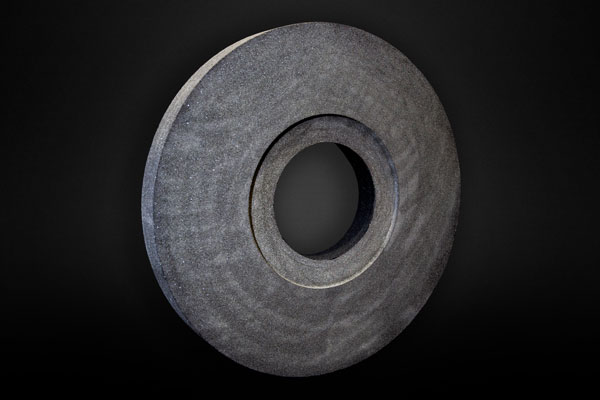
Various factors can affect the selection of the optimum grinding wheel specification, e.g. the power available to the machine and its general condition (bearings etc.), hardness and composition of the roll material and so on. The following are general recommendations found to be successful in most cases. To discuss your particular operation and requirements, please contact Phoenix.
Steel Industry
Hot mill work rolls:
Material = cast iron chrome, indefinite chill etc.
Wheel specification:
MC36T-J7-BRM, to achieve “commercial” finish, i.e. 0.8pm Ra (32 pinch CLA)
Cold mill work rolls:
Material = cast iron chrome, indefinite chill etc.
Wheel specification:
MA36T-J7-BRM for roughing, i.e. approx 0.8pm Ra (32 pinch CLA)
MA60T-J6-BR for semi-finish, i.e. approx 0.25pm Ra (11 pinch CLA)
C180-J7-E shellac bond for finishing, i.e. approx 0.1pm Ra (4 pinch CLA)
Back-up rolls
Material = steel
Wheel specification = A36-K7-BR
Paper Industry
“Suction” or drying rolls
Material = chilled iron
Wheel specification:
GC301-G7-B/SI for roughing
C80-L7-E shellac bond for finishing.
Material = stainless steel
Wheel specification:
GC303-H7-B/SI for roughing.
GC80-H7-BWR for finishing.
High performance abrasive
Some of the above applications, particularly hot-mill work roll grinding and paper mill drying roll grinding can increase grinding performance and consequently roll throughput by the use of sol-gel type abrasive in modified bond wheel formulations. Phoenix has had considerable success in these high performance grinding applications.
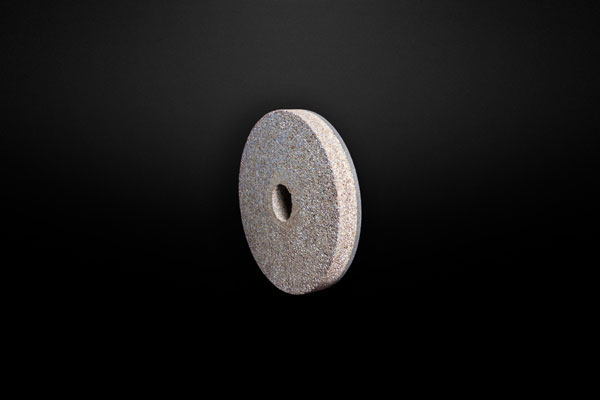
Grinding of rubber is a difficult application, due to the build up of rubber on the face of the grinding wheel. The friction then generated by the rubber-on-rubber contract, as the wheel cuts, combined with the poor thermal conductivity of rubber, leads to excessive heat generation. This, in turn, leads to wheel cracking and breakage. This problem manifests itself most acutely when vitrified wheels are used to grind soft rubbers. For this reason, the abrasive industry has often been hesitant to supply grinding wheels for this application.
Much depends on the hardness of the rubber to be ground. In general, the harder the rubber to be ground, the easier it is. So, for example an ebonite can be ground relatively easily with a conventionally structured vitrified wheel. For other harder rubbers, e.g. 80-90 Shore A Fluorocarbon elastomers, e.g. Viton, Aflas, etc., a soft resin-bonded wheel can be used.
Phoenix recommended wheel grading: C46-K7-B
However, the very soft rubbers commonly used in the offset-printing industry present the greatest difficulty to the abrasive supplier. These materials are inherently tacky and extremely elastic, leading them to clog the face of a grinding wheel very rapidly, in turn, leading to excessive heat generation and all the problems associated with it. Typical materials of this type include, EPDM, Chloroprene (Neoprene TM), Chlorosulfonated polyethylene rubber (Hypalon TM), Polyurethane rubber, etc.
Hardness in the region 30 – 50 shore A are not uncommon.
The most affective (and safest) way to grind these materials is with a resin-bonded bubble alumna wheel. The very high porosity of this wheel type allows the wheel to continue cutting, without clogging the face. The porosity also allows the heat dissipation, reducing the incidence of cracking and breakage
Phoenix recommend the following specifications for grinding this type of soft rubbers
Roughing: WBA24-K-BB
Finishing: WBA46-K-BB